We support Polish industry. We build local value
Why is local content important?
Local Content is one of the key elements in the development of offshore wind energy in Poland. Building a strong domestic supply chain strengthens the capabilities of Polish companies, increases their participation in projects, and supports sustainable economic growth.
The development of Local Content delivers not only economic benefits. From the perspective of project execution, it increases the resilience of the supply chain, shortens logistical routes, and supports the timely delivery of investments.
PGE Baltica fully supports the development of Local Content and treats it as part of its mission and one of the pillars of its offshore wind projects. Our goal is to create the widest possible opportunities for Polish companies to participate—both in the main execution packages and in the broad range of supplies and services across various levels of the value chain. We support the development of domestic competencies, ensure transparency in procurement processes, and actively cooperate with the Polish market so that Local Content genuinely reinforces the economy and the effectiveness of PGE Baltica’s projects.
We also expect our partners and main contractors to apply a similar approach—so that the participation of Polish companies in the projects is maximized at every stage and in every part of the supply chain, in line with national ambitions and the direction of development of the entire offshore wind sector.
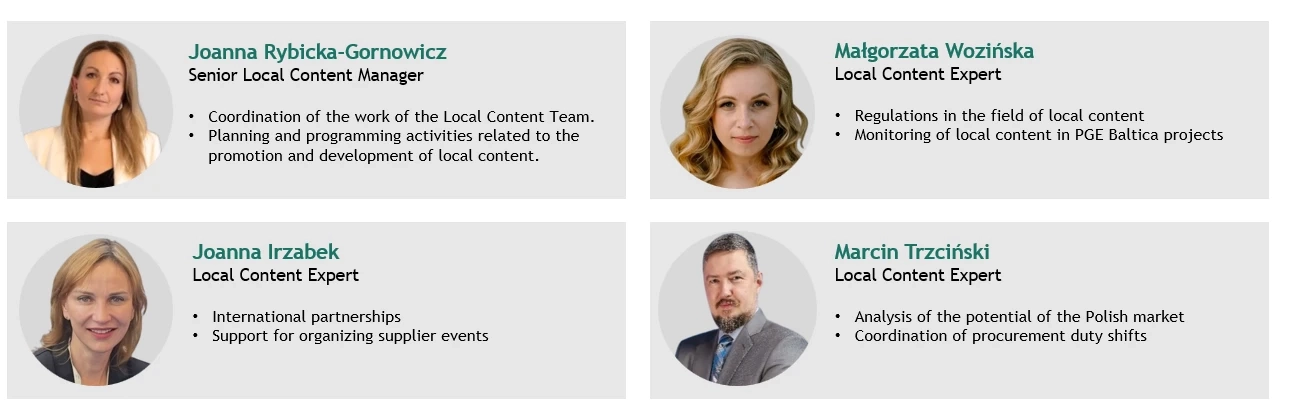
Local Content Team
The Local Content Team at PGE Baltica is responsible for increasing the participation of Polish suppliers and contractors in the company’s projects. We work with businesses, institutions, and technology partners to strengthen domestic capabilities and support the growth of the Polish economy.
Who are we?
The role of the Local Content Team is to actively identify opportunities to involve Polish companies in the offshore wind supply chain — primarily through supplier education, market dialogue, and modern forms of cooperation, such as information duty hours dedicated to potential suppliers.
PGE Baltica stimulates supply chain development by exploring the capabilities and expectations of Polish companies and clearly communicating its procurement needs and formal requirements. We organize individual meetings, procurement workshops, and — since July 2025 — run procurement duty hours in our office in Gdańsk.
Contact us: localcontent.pgebaltica@gkpge.pl
Our goals
- Increasing the share of Polish companies in projects implemented by PGE Baltica
- Ensuring a strong, integrated, and mature supply chain for offshore wind in Poland
- Developing domestic competencies
- Building long‑term relationships with the market
- Promoting Polish suppliers in international markets
- Transparent and accessible procurement processes
Results of our activities:
• Over 1,325 companies registered in the offshore wind supplier database
• 10 workshops held in 2025
• Over 90 visits to factories
• Over 300 meetings conducted
How do we support suppliers?
- We organize industry meetings, workshops, and Supplier Days
- We get to know suppliers’ capabilities during direct meetings in our Gdańsk office and during visits to the headquarters and production sites of Polish companies
- We publish information about procurement plans and required competencies
- We assist companies in the procurement system registration process
- We cooperate with business‑support institutions (technology parks, chambers of commerce, universities)
Get to know the offshore wind supply chain
In offshore wind project execution, multi‑contracting is the dominant approach—a model in which the developer signs from several to over a dozen Tier 1 contracts. This is a market standard used both across Europe and in the largest global markets.
It is important for Polish companies to understand that this model does not close the path to becoming a Tier 1 contractor. On the contrary—companies with the right experience, manufacturing capacity, technological capabilities, and relevant references can participate in these tenders and successfully compete at the highest level.
At the same time, the natural and very broad area of involvement for the domestic market remains Tier 2 and Tier 3, where the demand for components, structures, and logistical, research, and engineering services is significant.
It is crucial for every company to properly understand its place within the supply chain structure. Not every entity will work directly with the developer—and this is a natural feature of offshore wind projects.
The project’s contracting architecture defines who can be engaged, at what stage, and under what conditions. Understanding it enables companies to:
- assess whether the optimal development path is to operate independently or to combine capabilities with other entities—for example through a partnership, technological alliance, or consortium—to jointly meet the requirements of a Tier 1 or Tier 2 package,
- accurately identify the right business partners as well as their requirements and procurement processes,
- more effectively develop competencies and build a portfolio of references,
- better tailor their offer to the specific needs of individual project packages.
Therefore, if your company is considering entering the offshore wind supply chain and you want to better understand where your strongest opportunities lie within this structure—we are ready to help. Together, we can identify the appropriate development paths, requirements, and concrete business opportunities.
Would you like to initiate cooperation with PGE Baltica?
• Arrange a meeting with the Local Content Team
• Register for the procurement consultation sessions
• Register your company in the procurement system
• Familiarize yourself with supplier requirements at the upcoming workshop on 19 March 2025, held during PowerConnect 2026: https://powerconnect.pl/